
Textiles Skills
More actions
Textiles
 Textiles is a Refining crafting discipline that turns raw cotton, thread, scraps, wax, and special additives into refined cloth and textile components. These materials feed primarily into Tailoring, with straps and other components also used by Carpentry and additional recipe families.
Component choice matters. Cotton, Carapacian, and Fustian thread can become bolts and other parts with different recorded Material Crafting Bonuses on eligible finished equipment.[1]
Quick start
| Goal | Start here |
|---|---|
| Browse every recorded Textiles recipe | Textiles recipes |
| Learn or discover a recipe | Recipe Book |
| Compare cloth armor materials | Material Crafting Bonus and Armor Enhancement |
| Find straps and other component families | Crafting Component |
| Make finished cloth equipment | Tailoring Skills |
| Improve batch size, speed, or bonus output | The refining skills below |
| Find raw cotton | Foraging Skills, Agriculture Skills, and Raw Cotton |
What Textiles requires
| Requirement | Purpose |
|---|---|
| Textiles Station | Opens Textiles recipes |
| Loom Shuttle | Primary tool used by Textiles recipes |
| Recipe knowledge | Defines ingredients, quantities, skill requirement, and output |
| Fiber and secondary materials | Raw Cotton, thread, Fabric Scrap, Wax, Beetle Carapace, Suet, and other exact inputs |
| Textiles Proficiency | Base refining skill; advanced materials impose higher requirements |
| Producer Experience | Supplies the experience pool used to train Textiles skills |
The individual recipe is authoritative. A special thread is not a simple rename of Cotton thread, and a bolt, strap, or other component may require different materials and carry different effects.
From cotton to equipment
- Foraging harvests Raw Cotton from Cotton Bushes, while Agriculture can grow cotton crops.
- Textiles combines Raw Cotton and Wax into Cotton thread; a scraps recipe can recover thread using Fabric Scrap and Raw Cotton.
- Special recipes convert Cotton thread with an additive into Carapacian or Fustian thread.
- Further Textiles recipes turn thread into bolts, straps, and other components.
- Tailoring or another production discipline assembles compatible components into finished goods.
Release 50 added refining skills for larger batches, faster work, and chances at additional output.[2] These benefits apply to qualifying refined-material recipes, not automatically to every recipe performed at a Textiles Station.
What Textiles makes
| Family | Examples | Where it goes next |
|---|---|---|
| Thread | Spool of Cotton Thread, Spool of Carapacian Thread, and Spool of Fustian Thread | Cloth bolts and other textile components |
| Cloth bolts | Bolt of Cotton Cloth, Bolt of Carapacian Cloth, and Bolt of Fustian Cloth | Cloth armor, clothing, furnishings, and other Tailoring recipes |
| Straps | Material-specific cloth straps | Foci, belts, armor, and other compatible recipes |
| Bindings and components | Recipe-specific textile parts used in clothing, armor, and cross-discipline equipment | Crafting Component and the individual recipe |
| Scrap recovery | Thread or other refined material from qualifying scrap recipes | Re-enters the production chain |
| Decorations and specialty products | Recipe-specific fabric pieces and intermediate goods | Textiles recipes |
These families are navigation aids. The generated recipe list may include conversions and specialty components that do not accept the same substitutions as ordinary thread or cloth.
Choosing cloth components
The raw material name is only the beginning. A spool of thread, bolt of cloth, or cloth strap can carry a different effect or magnitude even when derived from the same material family.
| Goal | Material tendency in the versioned records |
|---|---|
| Basic flat Focus from cloth | Cotton components |
| Spell Critical Chance | Carapacian Cloth and related components |
| Percentage-based Focus | Fustian Cloth and related components |
| Wand or staff construction | The exact cloth or leather strap accepted by the recipe; see Focus Enhancement |
| Cloth armor | Every accepted bolt, binding, strap, and other component in the exact recipe |
Use Material Crafting Bonus for the versioned comparison and Armor Enhancement or Focus Enhancement for the finished equipment family. A displayed release is the component record's verification date, not necessarily its introduction date.
Skill tree
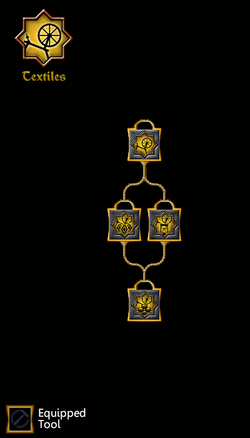
The recorded Textiles tree contains four innate refining skills and no active skills.
 |
Recorded skills
 |
Increases batch count for Textiles refine materials recipes |
 |
Adds chance to gain bonus materials for Textiles refine materials recipes |
 |
Decreases crafting time for Textiles refine materials recipes |
 |
Proficiency in Textiles |
| Skill | Recorded purpose |
|---|---|
| Textiles Proficiency | Raises Textiles level |
| Batching Materials - Textiles | Increases the permitted batch count for qualifying refined-material recipes |
| Swift Refine Materials - Textiles | Reduces crafting time for qualifying refined-material recipes |
| Efficient Refine Materials - Textiles | Adds a chance for bonus materials from qualifying refined-material recipes |
Textiles Proficiency records Release 28; the specialized refining skills record Release 50. Check current tooltips and recipe classification before relying on historical numerical effects.
Batching, speed, and efficiency
Batching changes how many qualifying operations can be queued together; it does not remove the ingredients required for each operation. Swift refining reduces time. Efficient refining records a chance for bonus material rather than a guaranteed extra result.
Being listed under Textiles does not alone prove that all three bonuses apply. Verify that the current interface classifies a special component or conversion as a refined-material recipe before planning a large batch.
Recipes
The generated Textiles recipes index is populated from recipe data stored on individual item pages. Edit the item or recipe record rather than manually adding a row to the index. Its longstanding verification banner means individual records and current-client testing remain important.
Some recipes are Discoverable, Teachable, or Re-Teachable, while special materials may be explicitly not teachable. See Recipe Book and the individual recipe's current status.
Version and verification
A lastseen release says when a wiki record was checked, not necessarily when it was introduced. For example, current records for the thread and bolt families span several releases, so comparison pages expose those versions instead of presenting every value as freshly tested.
When testing Textiles data, note the game release, station, Loom Shuttle, exact ingredients, skill level, batch size, output, bonus result, and component tooltip. Special-thread inputs and refining-efficiency behavior deserve particular care.
See also


References
- ↑ Release 23 Instructions, official Shroud of the Avatar website, October 29, 2015.
- ↑ Release 50 Instructions, official Shroud of the Avatar website, January 25, 2018.