
Resource Node
More actions
Resource Node

A Resource Node is an interactable source of raw materials. Trees, ore veins, reagent plants, creature remains, cultivated crops, and fishing water all feed the broader Gathering workflow, although their tools and interaction rules differ.
Most nodes alternate between an active state, when they can be gathered, and an inactive or depleted state. A successful collection usually consumes the node unless Meticulous Collection or another current gathering mechanic permits an additional pull. Depleted world nodes can become active again after their respawn conditions are met.
Gathering a node
For an ordinary gathering node, an Avatar generally needs:
- the appropriate gathering discipline and sufficient skill;
- a compatible tool with durability remaining;
- access to an active node; and
- enough carrying capacity to receive the results.
Interact with the highlighted node to begin the attempt. A failed attempt leaves the node available for another try, while success awards materials and Producer Experience. The exact yield, experience, success chance, and tool wear depend on the node, scene, skills, equipment, and current game rules.
Active gathering meter
Release 154 added an optional active meter to Mining, Forestry, Foraging, and Field Dressing. Timing the action near the center can produce a Clean Strike, worth 1.5 times the normal experience, while a Rich Find can add pulls to the gathering chain. Skill affects the meter. Players who prefer the earlier interaction can use classic mode.[1]
Fishing uses its own active interaction for applicable catches, and Agriculture follows its planting and growth cycle. They should not be assumed to behave exactly like the four ordinary node disciplines.
Node tiers and scene information
Resource nodes can have different tiers. Higher-tier nodes generally carry greater difficulty and can award more experience, but a scene can contain nodes of more than one tier. Scene and node records should therefore be used instead of treating the scene's overall tier as a guarantee for every harvest.
On the overworld, a scene's information display can identify resources associated with that scene. The established display convention uses white text for plentiful resources and gray text for resources present in small numbers. Scene information was expanded during Release 47, but it should be treated as a useful guide rather than a map of every individual spawn point.[2]
The gathering skill's Survey ability helps reveal appropriate nearby nodes. It improves detection rather than creating new resources or increasing the node's yield.
Meticulous Collection
Meticulous Collection provides a chance for a successful gather not to consume the node, permitting another collection cycle. A single node can sustain multiple meticulous successes before the chain ends. This is additional access to the node, not a promise that every item from the first pull will be duplicated.[3]
Experience from a meticulous chain is based on the underlying node and the successful pulls. Meticulous gathering can award both Producer and Adventure experience; the resulting awards are applied to their corresponding pools.[4] Consult the current skill tooltip and gathering results before relying on an old fixed value.
Gathering disciplines and tools
| Discipline | Common interaction | Primary tool or requirement | Representative nodes or targets |
|---|---|---|---|
| Mining | Extract minerals, ore, gems, and stone | Pickaxe | Copper Vein, Iron Vein, Silver Vein, Gold Vein, crystals, granite, salt, coal, clay, ash, and brimstone deposits |
| Forestry | Harvest wood and related materials | Harvesting Axe | Pine Tree, Maple Tree, and their regional variants |
| Field Dressing | Process eligible creature remains | Skinning Knife | Animal and creature corpses that support field dressing |
| Foraging | Gather plants, reagents, and certain natural deposits | Sickle | Cotton Plant, reagent plants, Oyster Bed, coconuts, pumpkins, and other forage nodes |
| Agriculture | Plant, water, grow, and harvest cultivated crops | Hoe, seed, water, and a suitable planting location | Planters, planting beds, and agriculture plots |
| Fishing | Cast into suitable water or lava and land a catch | Fishing Rod or Lava Fishing Rod, with appropriate Bait | Freshwater, Saltwater, Fetid Water, and Lava |
This table summarizes the major disciplines rather than attempting to enumerate every named node. New scenes, encounter objects, quest interactions, and special deposits may follow narrower rules. Use the navigation box and individual resource pages for recorded locations and yields.
Examples in the world
-
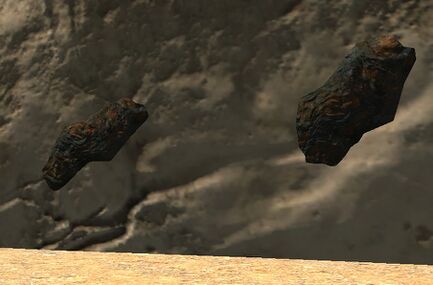 Early examples of ore nodes used for Mining.
-
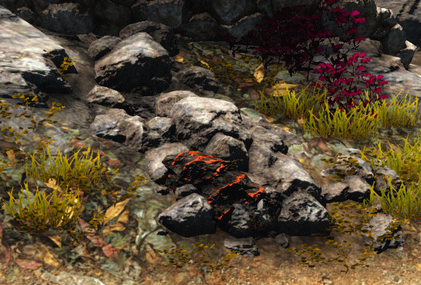 A Copper Vein ready for Mining.
-
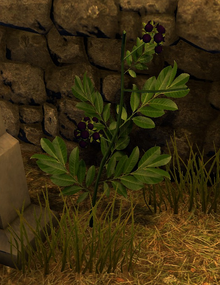 A Nightshade Plant, gathered through Foraging or grown through Agriculture.
-
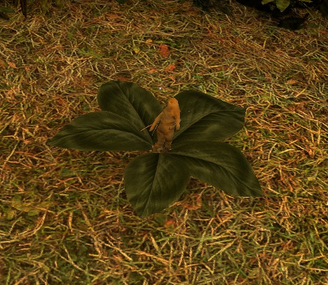 A Mandrake Plant, another reagent-producing plant.
-
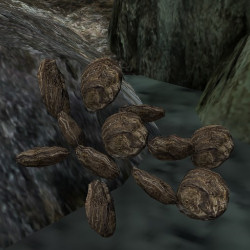 An Oyster Bed, a coastal Foraging target.


This article needs verification. (Specific reason: Add clear, current in-game screenshots representing the resource interactions not yet pictured here: a Forestry tree before harvesting, a field-dressable creature corpse, a mature cultivated plant in a planter or planting bed, and a Fishing target in water or lava. Include the scene, release or client build, and a descriptive filename when uploading.)
Help verify this page. You do not need to edit anything.
See the talk page for details.
The gallery uses images already uploaded to SotAwiki. Additional screenshots should show the interactable target clearly, preferably before collection and without unrelated interface windows obscuring it.
Improving efficiency
Several systems can improve gathering, depending on the discipline:
- Proficiency improves the core gathering ability and can affect success.
- Survey improves the visibility or detection range of appropriate nodes.
- Swift Gathering reduces the time required for supported gathering actions.
- Meticulous Collection adds a chance for another collection cycle.
- Tools, tool bonuses, consumables, artifacts, and socketed effects can modify particular gathering statistics.
- The Release 154 active meter rewards accurate timing through Clean Strikes and Rich Finds when that mode applies.
Fishing and Agriculture have distinct supporting mechanics, so not every modifier above exists in every gathering tree. Review the relevant discipline page and current skill tooltip before comparing bonuses.
Recording node information
When documenting a resource node, record enough context for another player to reproduce the observation:
- game release or client build;
- scene and approximate location;
- node name and apparent tier;
- gathering discipline and tool;
- relevant skill, equipment, potion, and other bonuses;
- every item and quantity received;
- experience awarded; and
- whether Clean Strike, Rich Find, or Meticulous Collection triggered.
One collection is evidence that an item can appear, not proof of its normal rate or complete loot table.
See also
| Fishing | |
|---|---|
| Foraging | |
| Forestry | |
| Mining | |
| Agriculture | |
| Fishing |
References
- ↑ What's New, Catnip Games development collection used for the Release 154 launch baseline, September 28, 2026; see also Release 154.
- ↑ Release 47 Instructions, official Shroud of the Avatar website, October 26, 2017.
- ↑ Release 15 Instructions, official Shroud of the Avatar forum, February 26, 2015.
- ↑ Avatar's Update #380, official Shroud of the Avatar website, May 8, 2020.